Financial education through experience
Interactive Markets With Price Discovery
Some things can only be experienced. One of these is a live trading floor, where orders are submitted, prices are negotiated, activity is fast paced and competitive, and everyone reacts in real time to the actions of others. FTS creates this experience in an educational setting.
Learning through price discovery
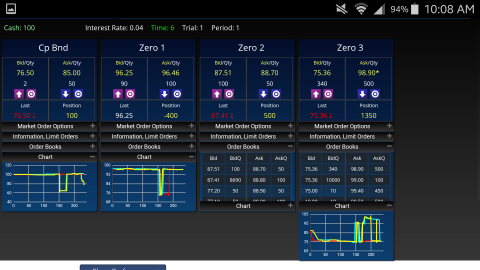
FTS Interactive Markets are different from conventional paper-trading simulations. Rather than simply trading at externally supplied prices, students submit bids, asks, and orders to one another, so their decisions create the market price. Each market is organized around a carefully designed trading case with clear learning objectives, ensuring that the trading experience reinforces specific financial concepts.
Use FTS in a dedicated trading room, a conventional classroom, or an online or hybrid course. Instructors and students can connect from computers, tablets, or phones.
FTS Prediction Markets
Students analyze real-world questions and data, trade contracts on possible outcomes, and see the class’s collective judgment emerge as market-implied probabilities.
Experience the B02 Price Discovery Demo
Join a continuing classroom bond market, trade alongside its preserved history, and then explore the dashboard showing price discovery, market efficiency, trader behavior, and performance.
Explore Trading Cases
Bonds, stocks, options, futures, swaps, currencies, risk management, and more.
Practice Trading
Open FTS Web Trader and select “Connect to Demo” to practice the mechanics of trading.
Instructor Guide
Learn how to select a case, prepare students, run the market, and discuss the results.
How it works
- What is traded is specified in a trading case with clear learning objectives.
- The instructor selects the case and starts the market.
- Students submit bids, asks, buy orders, and sell orders to one another in a competitive market.
- Trade execution is immediate, and every short trading period provides performance feedback.
- The simulation is repeated to let the market evolve and make the learning apparent.
What students learn
- What it is like to trade and how a market actually works.
- Price discovery, market efficiency, market impact, liquidity, and other practical features of an exchange.
- The behavior of stocks, bonds, options, forwards, futures, swaps, and currencies.
- Core financial concepts including time value of money, market efficiency, option pricing, and cost of carry.
Cloud-Based System
A flexible choice for dedicated trading rooms, conventional classrooms, online courses, and hybrid programs.
Run markets in any learning environment
- Instructors can start and run a market from almost any device
- Students can connect from phones, tablets, or computers
- Works in trading rooms and computer-equipped classrooms, but does not require either
- Ideal for online and hybrid courses
Windows System
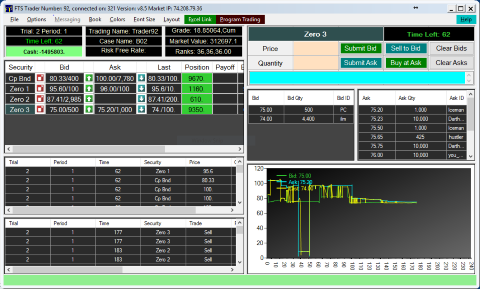
The full-featured FTS platform for advanced instruction, automation, and experimental market research.
Advanced tools and greater control
- Real-time Excel integration
- Program-trading capabilities
- Alternative market microstructures
- Advanced cases and experimental research features
Teaching and learning resources
Preparation material, quick-start instructions, case support, and advanced feature documentation.
Market experiments and academic research
FTS has its origins in research. Professors John O’Brien and Sanjay Srivastava originally designed the platform at Carnegie Mellon University to study how participants trade, learn, and form prices in interactive markets.
Dynamic Stock Markets with Multiple Assets: An Experimental Analysis
John O’Brien and Sanjay Srivastava · Journal of Finance · December 1991 · Volume 46, Issue 5 · Pages 1811–1838
This pioneering study established the academic foundation for FTS and demonstrated how controlled, interactive markets can be used to investigate trading behavior and price formation.
View the paper on JSTORSelected papers written using FTS
Building educational markets since 1992
FTS combines decades of academic research, case development, and classroom experience in a platform created and supported by university professors.
Dynamic Stock Markets with Multiple Assets: An Experimental Analysis
John O’Brien and Sanjay Srivastava · Journal of Finance · December 1991 · Volume 46, Issue 5 · Pages 1811–1838
The paper introduced the research foundation from which the FTS platform developed. View the paper on JSTOR.
Professors John O’Brien and Sanjay Srivastava originally designed FTS through the FAST Lab at Carnegie Mellon University. They remain active in case development and instructor support.
The FAST Lab was the first educational trading room at a business school. The Smithsonian Institution’s Archive of American History made its pioneering work part of the permanent research collection on innovative information technology and awarded it a Computerworld-Smithsonian medal.
Contact: ftsweb@gmail.com · (+1) 800 214 3480