 13.2 Applications:
Stock Options
13.2 Applications:
Stock Options
13.2 Applications:
Stock Options
In this topic we apply the tools of option pricing theory to
value options trading on IBM at the close of trading on March 24, 1994.
These are American options trading on (dividend-paying) IBM stock, traded
on the Chicago Board of Trade (CBOT).
An American option on a dividend-paying stock immediately
creates some practical problems. The
most formidable is that there is no closed-form solution to this type of
valuation problem. As a result, we
have to resort to numerical methods to compute the option's value.
Online, you can apply the Option Calculator in Option
Tutor to compute the values of (American) options traded on IBM.
Table 13.1 shows how option prices are quoted in the financial press
(e.g. in The Wall Street Journal).
Column information is interpreted as follows.
Column 1:
The company name, IBM, and the stock’s closing price (from the NYSE).
Column 2:
The strike or exercise price of the option.
Column 3:
The expiration date of the option. Recall
that stock options expire on the Saturday after the third Friday of the month
listed.
Column 4:
An estimate of open interest for the call option.
That is, the number of option contracts outstanding for all exchanges for
the previous trading day (one contract is for 100 stocks).
Note that this information is one-day old, but the price information is
current.
Column 5:
The last traded price for the call option.
Column 6:
Same as column 4, except for the put option; an estimate of open interest
for the put option.
Column 7:
The last traded price for the put option.
A blank
entry in the table means that the option did not trade.
Table
13.1
Option
Prices
|
Option |
|
Expiration |
-Call- |
-Put- |
| ||
|
IBM |
Strike |
Month |
Volume |
Last |
Volume |
Last |
|
|
|
45 |
July |
20 |
12 |
39 |
5/16 |
|
|
56 3/8 |
50 |
April |
205 |
6 5/8 |
568 |
1/8 |
|
|
56 3/8 |
50 |
May |
19 |
7 |
156 |
1/2 |
|
|
56 3/8 |
50 |
July |
111 |
7 3/4 |
106 |
1 3/16 |
|
|
56 3/8 |
55 |
April |
5452 |
2 1/2 |
4076 |
1 |
|
|
56 3/8 |
55 |
May |
268 |
3 1/2 |
454 |
1 15/16 |
|
|
56 3/8 |
55 |
July |
330 |
4 5/8 |
336 |
2 13/16 |
|
|
56 3/8 |
55 |
October |
86 |
6 1/8 |
744 |
3 3/4 |
|
|
56 3/8 |
60 |
April |
4304 |
1/2 |
282 |
4 1/8 |
|
|
56 3/8 |
60 |
May |
806 |
1 5/16 |
202 |
5 |
|
|
56 3/8 |
60 |
July |
627 |
2 3/8 |
145 |
5 5/8 |
|
|
56 3/8 |
60 |
October |
836 |
3 3/4 |
8 |
6 5/8 |
|
|
56 3/8 |
65 |
April |
737 |
1/8 |
|
|
|
|
56 3/8 |
65 |
May |
128 |
7/16 |
|
|
|
|
56 3/8 |
65 |
July |
484 |
1 1/16 |
|
|
|
|
56 3/8 |
65 |
October |
52 |
2 3/16 |
|
|
|
|
56 3/8 |
70 |
July |
298 |
1/2 |
|
|
|
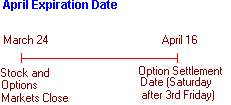
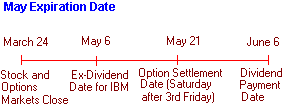
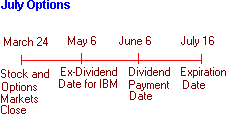
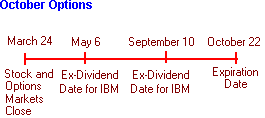
The timing of dividend-related complications are summarized
in the time lines shown in Figure 13.1.
This figure shows you the
critical event dates for the four
expiration months listed in Table 13.1.
Figure 13.1
IBM Option Event Dates
Critical Events
Markets have just completed trading on March 24, 1994.
This fixes the starting date for
determining the remaining life of an
option.
The options are settled on the Saturday after the third
Friday of the expiration month. The
expiration dates are shown on the time
lines.
We have to convert the remaining life of each option into a
proportion of a year.
For example, you can calculate that
there are 58 days remaining in the life of
any May expiration IBM option.
The option pricing model requires
us to express the remaining life in days
as an "annualized time," which
here is 58/365 = 0.1589 of a year.
Online, you can enter the May expiration date, 5/21/94, as
well as “today's date” (which here is
3/24/94) into the date calculator.
If you click on OK, the date
calculator will automatically place the
value 0.1589 into the Maturity field of
the calculator.
The remaining two events in the time line relate to
dividends.
Observe that IBM stock goes
ex-dividend twice during the lives of
these options. The first is in May, and this affects all but the April
option.
The second is in September, which
only affects the October option.
Dividends affect option values,
because if you buy a stock after
ex-dividend date, you do not get the
dividends just declared (although you
would be entitled to future dividends).
The effect of the May ex-dividend date is that IBM's stock
price will adjust for the dividend on this
date, (even though the actual payment date
is June 6, 1994).
Since the value of the option
depends on the stock price, the
ex-dividend price is what is relevant to
optionholders.
Similarly, the price will change
when the stock goes ex-dividend in
September.
The effects of these dividend
payments need to be taken into account
when valuing the option on March 24.
In order to apply the Black-Scholes option pricing model, we
adjust the current IBM stock price by the
present value of the projected
dividend payment.
To do so we need to know five
pieces of information:
1. The
contractual details of the option, such as
maturity date, strike or exercise price,
type (American or European), and whether
it is a put or a call.
2. The term
structure of default-free interest rates.
3. Estimated
dividends over the life of the option.
4. The
volatility of IBM stock.
5. The
appropriate discount rate for critical
cash flow events (such as the payment of
dividends).
IBM options are American and the current strike prices being
traded are provided in Table 13.1. The
time to maturity is computed from the
current date (now) to the Saturday after
the third Friday of the option's
expiration month.
For interest rates, we use the yields on Treasury bills that
mature at dates very close to the option
maturity date and also the ex-dividend
date.
For the latter we will assume that
the default-free interest rate is accurate
to the cent.
These yields (on March 24) are
shown in Table 13.2.
Table 13.2
Treasury Bill Yields
|
Date |
Yield
to Maturity |
|
|
April
16, 1994 |
0.032 |
|
|
May
21, 1994 |
0.034 |
|
|
June
10, 1994 |
0.035 |
|
|
July
16, 1994 |
0.037 |
|
|
September
10, 1994 |
0.04 |
|
|
October
22, 1994 |
0.041 |
|
This table gives you appropriate risk-free interest rates for
the option valuation
problem.
You may recall that
in the Black-Scholes model,
interest rates are assumed
to be constant.
As the table reveals,
in fact they vary with the
time to maturity.
To accommodate this problem, we simply make an approximation
that is widely used in
practice: we value the
option using the yield to
maturity of the Treasury
bill closest to the maturity
date.
For an appropriate
discount rate for dividends,
given the relatively short
times involved, the term
structure of Treasury bills
provides a close enough
estimate.
IBM's last quarter dividend is our estimate for the current
quarter's dividend.
Information on IBM's
recent dividend history
appears in Table 13.3.
Table 13.3
IBM’s Recent Dividend
History
|
Rate |
Type |
Ex-Date |
Payment
Date |
|
|
$0.54 |
Cash |
2/4/93 |
3/10/93 |
|
|
$0.54 |
Cash |
5/6/93 |
6/10/93 |
|
|
$0.25 |
Cash |
8/5/93 |
9/10/93 |
|
|
$0.25 |
Cash |
11/4/93 |
12/10/93 |
|
|
$0.25 |
Cash |
2/4/93 |
3/10/93 |
|
The closing stock price of IBM on March 24, 1994, was
$56.375.
For all
but the April
options, we have
to subtract the
present value of
both dividend
payments.
For the
May option, we
have to subtract
only the present
value of the
first dividend.
When adjusted for the present value of one dividend
payment, the
"stock
price"
equals
$56.127.
When
adjusted for the
present value of
both dividend
payments, it
equals $55.879.
Finally, we need to estimate the volatility.
The
Black-Scholes
model assumes
that the
volatility
remains constant
over time.
Suppose
that volatility
has been
estimated from
recent IBM
activity to be
0.30, or 30%, on
an annualized
basis.
Later,
you will see how
volatility can
be inferred from
current option
prices; this
will let you
compute your own
estimates of
volatility.
Volatility
can also be
estimated using
the historical
standard
deviation of the
stock return; in
this case, the
estimate is
called the
historical
volatility.
We will value the options that are close to being
"at-the-money."
Online,
you can compute
your own values
using the
calculator. Observe that there are four maturity months:
April,
May, July, and
October.
Table
13.4 provides
the relevant
data for each
maturity month
for the Option
Calculator.
Table 13.4
Maturity Month Data
|
Maturity
Month |
Maturity
(Annualized) |
Risk-free
Rate |
Price
(Dividend
Adjusted
When
Necessary) |
|
|
April
|
0.063 |
0.032 |
56.375 |
|
|
May |
0.1589 |
0.034 |
56.127 |
|
|
July |
0.3123 |
0.037 |
56.127 |
|
|
October |
0.5808 |
0.041 |
55.879 |
|
We consider here only the strike $55 options and leave
additional
pricing
problems
as
exercises.
You
can
observe
that
for
April
options
there
are no
dividends,
so
this
assumption
of the
basic
model
is
met.
Call Option
Since an American call option on a non-dividend-paying stock
has
the
same
value
as a
European
call
option,
you
can
compute
the
April
call
values
directly
using
the
Black-Scholes
formula.
The variables are:
|
Strike Price: |
$55 |
|
|
Time to maturity: |
0.063 |
|
|
Risk-free rate: |
0.034 |
|
|
Stock price: |
56.375 |
|
|
Volatility: |
0.30 |
|
The Black-Scholes price (binomial option price) is 2.52. The
market
price
is
2.50.
An
interesting
check
on
these
prices
is
to
compute
the
American
option
value
using
the
binomial
(200
iterations).
Under
these
conditions,
it
should
provide
the
same
answer
as
the
Black-Scholes
value,
which
it
does.
The
finite
difference
approximation,
however,
is
not
as
accurate
for
a
grid
size
of
200
x
200
(Call
price
=
2.275).
Put Option
For an April put option, the European option price is not
correct,
because
it
may
be
worth
exercising
an
American
put
early
with
or
without
dividends.
But
you
can
see
that
the
European
formula
still
provides
a
reasonable
approximation.
As
expected,
however,
the
binomial
model
value
for
the
American
put
option
is
a
little
higher
than
the
European
price.
Black-Scholes put price: 1.029
Binomial American put price: 1.035
Market price:
1.00
At the assumed volatility, both models slightly overprice the
option
relative
to
the
actual
market
price.
For other maturities you can use the dividend-adjusted prices
for
both
the
Black-Scholes
(European
pricing)
model
as
well
as
the
binomial
pricing
model.
For
both
types
of
American
options,
this
adjustment
is
a
little
crude
because
it
does
not
fully
take
into
account
the
value
of
early
exercise. We suspect that this affects the put option's value more than
the
call
option's
value.
Online, you can use the calculator to verify the numbers in
Table
13.5.
Table 13.5
Options Data
|
Maturity
(X
=
55
) |
American
Call |
B-S
Call |
American
Put |
B-S
Put |
Market
Call
Price |
Market
Put
Price |
|
|
April |
2.520 |
2.520 |
1.035 |
1.029 |
2.500 |
1.0000 |
|
|
May |
3.415 |
3.415 |
2.010 |
1.990 |
3.500 |
1.9375 |
|
|
July |
4.631 |
4.636 |
2.919 |
2.878 |
4.625 |
2.8125 |
|
|
October |
6.129 |
6.148 |
4.085 |
3.975 |
6.125 |
3.7500 |
|
You can observe that the constant volatility,
dividend-adjusted
model
provides
a
fairly
accurate
estimate
of
the
market
values
for
the
call
options.
The
longer-maturity
call
options
are
within
one
cent,
and
only
the
May
maturity
varies
by
more
than
three
cents.
The American put option is less accurate, which is not
surprising,
because
we
are
using
the
present
value
of
the
dividend
adjustment,
which
understates
the
value
of
early
exercise.
Later
we
will
see
another
proxy
for
dividend
adjustment,
called
the
constant
dividend
yield
model,
and
we
will
examine
the
result
of
this
adjustment.
Implied Volatilities
and
Informational
Implications
from
Option
Prices
Given option prices, we can turn the option pricing problem
around
to
ask
the
question:
What
is
the
implied
volatility?
What this means is that we take the pricing model as being
fixed,
and
find
the
volatility
that
makes
the
model
price
equal
to
the
market
price.
This
estimate
of
volatility
is
called
the
implied
volatility.
When we do this, you will see that the constant volatility
assumption
may
be
inappropriate.
Table
13.6
provides
the
implied
volatilities
for
both
the
Black-Scholes
and
the
binomial
pricing
models
(using
50
steps)
for
the
May-maturity
options.
Table 13.6
Implied Volatility
Estimates
|
Maturity |
Strike |
B-S
Call
Volatility |
American
Call
Volatility |
B-S
Put
Volatility |
American
Put
Volatility |
Market
Call
Price |
Market
Put
Price |
|
|
May |
50 |
0.317 |
0.317 |
0.297 |
0.296 |
7.0000 |
0.5000 |
|
|
May |
55 |
0.310 |
0.310 |
0.294 |
0.291 |
3.5000 |
1.9375 |
|
|
May |
60 |
0.297 |
0.298 |
0.314 |
0.308 |
1.3125 |
5.0000 |
|
|
May |
65 |
0.178 |
0.178 |
|
|
0.4375 |
|
|
You can see evidence of what is called the "volatility
smile"
developing
in
the
put
options,
although
not
in
the
call
options.
The
volatility
smile
is
a
systematic
pattern
of
implied
volatilities
that
are
high
for
low
strike
prices,
then
fall
as
strikes
increase,
but
increase
again
as
strike
prices
increase
further.
This
pattern
traces
out
the
shape
of
a
smile
when
graphed,
which
gives
rise
to
its
name.
Different implied volatility shapes are often taken as
evidence
of
stochastic
volatility.
If
volatility
is
indeed
stochastic,
then
the
option
pricing
models
discussed
so
far
are
missing
a
risk
premium
term.
This
term
compensates
risk-averse
investors
for
this
source
of
risk.
In our case, the May 65 call option appears to be underpriced
relative
to
the
other
call
options,
yet
the
May
60
put
appears
to
be
overpriced
relative
to
the
other
puts.
This
type
of
observation
is
consistent
with
a
stock
price
distribution
that
deviates
from
the
lognormal
distribution.
In
particular,
these
prices
are
consistent
with
a
market
distribution
that
has
a
fatter
left
tail
than
is
assumed
by
the
pricing
model.
That
is,
prices
are
consistent
with
a
market
that
is
putting
more
weight
on
the
possibility
of
an
IBM
price
decline
on
March
24,
1994,
than
would
be
the
case
with
a
lognormal
distribution.
If this is the case, we would expect to get the smile in the
put
options.
We
would
expect
no
smile
in
the
call
options.
By the way, the price of IBM declined in the days following
March
24!
In the next topic, Applications:
Currency
Forwards
and
Futures,
we
will
work
through
an
application
of
the
theory
to
the
currency
markets.
(C) Copyright 1999, OS
Financial Trading System